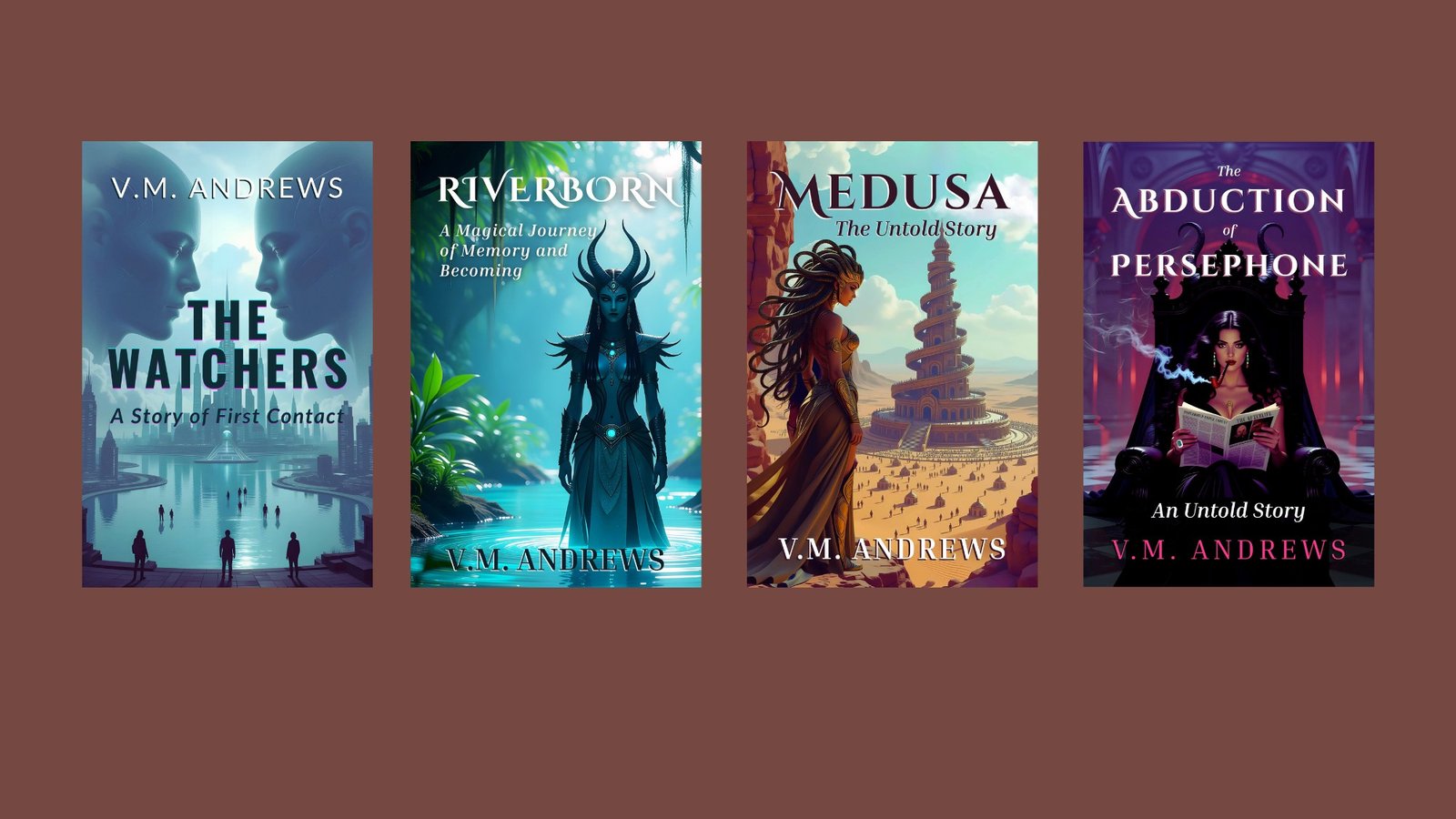
It is said that all art is a self-portrait, an expression that resonates strongly as I reflect on the month of June 2026. Across the last four weeks, I have released four articles, each offering reflections on one of the short stories in my ‘Visions to Words’ collection.
I began the month talking about The Watchers: A Story of First Contact with an increasing suspicion that stories of alien invasion endure because they dramatise a question that lives far beyond science fiction. The question is: what happens when the outside enters?
That ‘outside’ may be extraterrestrial, spiritual, psychological, technological, ecological, political, or personal. It can arrive as a new idea, an illness, or a revelation. In the case of ‘The Watchers’, it arrives as a bizarre species from another star.
Their tactic: stun the terrestrial populations they visit while downloading ideas for innovations those populations have yet to conceive. And while they are at it, the Watchers alter those populations’ collective memories, leaving them with the belief that they, the Watchers, have been with them forever.
One reader described it as ‘an insidious invasion’, and I agree.
In Riverborn: A Magical Journey into Memory and Becoming, memory is internal. It is not imposed by an invader, but held in water, silt, stone, body, and dream. It does not arrive as an invasion, but as an inheritance. It flows through the Riverborn creatures: beings that emerge from the river in many forms, each incarnation carrying something from the last, even when their physical form has changed.
Across their sequence of forms and purposes, the Riverborn creatures evolve. The early emergences carry surprise and instinct, sometimes confusion. Later forms carry force, grief, and anger. Still later, something quieter begins to appear in the form of discernment, restraint, and a deeper understanding of purpose.
Other stories arrive in our lives already decided. The traditional Medusa myth is, in many ways, one of the most brutal examples of narrative punishment. In the commonly told version, Medusa is assaulted by Poseidon, punished by Athena, transformed into a monster, exiled, hunted, and finally beheaded by Perseus, who then uses her severed head as a weapon. Her suffering becomes her punishment, her body becomes a warning, and her name becomes code for ‘abomination’.
That version of the myth has always troubled me, not only because it is cruel, but because its cruelty is so efficient. It does not merely punish Medusa; it explains why punishing her was necessary. It teaches us to fear her before we are invited to know her. It turns the victim into the threat and the killer into the hero.
That pattern felt too familiar to leave untouched, so I began from the opposite premise.
I wondered: What if Medusa was never cursed, but chosen? What if her transformation was not a punishment, but an awakening? What if her silent gaze, unruly hair, and ability to unsettle those around her were not signs of evil, but signs of heightened perception? And what if she was not monstrous because she had fallen from grace, but because history could not tolerate the shape of her power?
I simply had to explore those questions in Medusa: The Untold Story. In my version of her story, Pegasus is her child of freedom, born from her own living force. Aetherion, her luminous child of light, is also born from that same field of resonance. Medusa’s motherhood finally becomes an expression of her abundance, not her condemnation.
Retelling old myths is more than placing modern costumes on ancient bodies. It is an act of inquiry and excavation. It forces the writer and reader to ask what lies beneath the official version. In doing so, it allows the maligned and the silenced to become real and complex again.
Following this line of thought, I moved on to explore the story of Persephone. As myth would have it, she was the naive Goddess of Spring captured by Hades, Ruler of the Underworld, who brought her into the darkness, mistreated her, and forced her to become his unwilling queen. It is a myth framed around violation, grief, possession, and patriarchal negotiation, almost in a way that glorifies those things.
In writing The Abduction of Persephone: An Untold Story, I wanted to disturb that tedious structure. I see Persephone is a spirited young goddess bored with sameness and perfection. Seeking a challenge, she summons Hades to rise from the Underworld and take her for a spin in his golden chariot. What she does not expect is the cascade of erotic sensations she feels when Hades is near her.
Hades, too, is taken aback by his feelings for her. No longer the ruler who had mistaken emotional deadness for strength and order, his new emotions are disruptive, and the Underworld transforms in response. Cerberus is overjoyed, the Shades become more alert, the Furies soften, the rivers shift, the air becomes lighter, and the light learns to behave differently. Even the dead turn and stare at the lovers.
One of the great pleasures of writing this story was the experience of riding the boundaries between several subgenres: magical realism, dark romance, and mythic retelling. The strongest heartbeat of the story is Persephone’s choice to move between the Underworld and the living world above. This choice is not made for her. She makes it herself. In doing so, restores balance between the worlds, giving rise to the four seasons.
These stories are not simply speculative, mythic, or lyrical exercises. They are all concerned with the strange relationship between rupture and continuity. They ask whether we can be altered while remaining ourselves. Whether we can descend and return. Whether we can inherit old stories without being imprisoned by them.
Looking back, I can see that June’s articles were less separate reflections than variations on a single question. What happens when the story changes? What happens when the invasion is subtle, the memory is ancient, the monster is misunderstood, or the abducted goddess was never as powerless as the old tale insisted?
Perhaps that is why the idea of art as self-portrait feels so apt to me now. Again and again, I seem to return to characters, creatures, and worlds standing at the threshold of transformation. Something enters. Something awakens. Something remembered or misremembered asks to be seen again.
[If you would like digital versions of these stories, and the original artworks that inspired them, check out the bundles from the links above].