Some stories arrive in our lives already decided.
They come to us with their heroes polished, their monsters named, and their moral lessons neatly arranged. We were told to believe that Perseus was brave, his sword was righteous, Medusa was monstrous, and her severed head was proof of his victory.
I suspect the story was different. I mean, who gets to decide what a monster is? What happens when the person called ‘dangerous’ is only powerful in a way others cannot understand? When does transformation become a curse, and when is it a calling? How many of the stories we inherit are less about truth and more acts of propaganda?
The traditional Medusa myth is, in many ways, one of the most brutal examples of narrative punishment. In the commonly told version, Medusa is assaulted by Poseidon, punished by Athena, transformed into a monster, exiled, hunted, and finally beheaded by Perseus, who then uses her severed head as a weapon. Her suffering becomes her punishment, her body becomes a warning, and her name becomes shorthand for ‘horror’.
That version of the myth has always troubled me, not only because it is cruel, but because its cruelty is so efficient. It does not merely punish Medusa; it explains why punishing her was necessary. It teaches us to fear her before we are invited to know her. It turns the victim into the threat and the killer into the hero.
That pattern felt too familiar to leave untouched, so I began from the opposite premise. I wondered: What if Medusa was never cursed but chosen? What if her transformation was not a punishment, but an awakening? What if her silent gaze, unruly hair, and ability to unsettle those around her were not signs of evil, but signs of perception? What if she was not monstrous because she had fallen from grace, but because history could not tolerate the shape of her power?
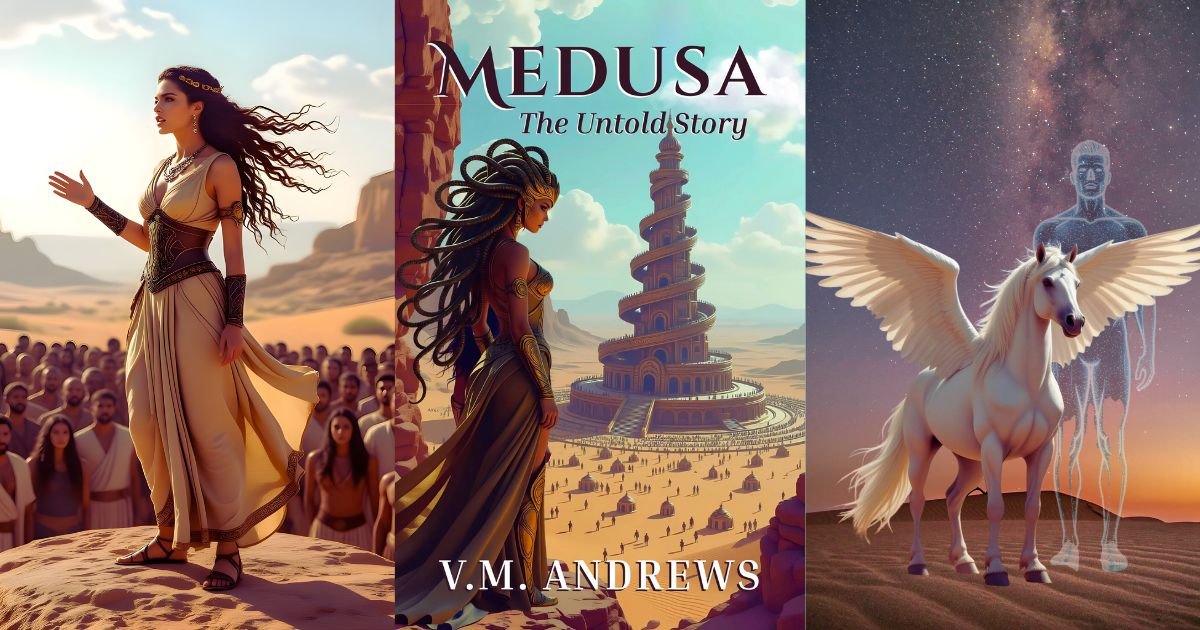
In my version, Medusa begins as a poor sand-sweeper in a desert outpost, a place of wind, dust, labour, and scarcity. She is not noble, adored, or elevated. She is marginalised, mocked, and misunderstood. Her people see her as strange because she is quiet, listens too deeply, and is attentive in an unusual way.
But what her community mistakes for oddness is genuine sensitivity. Medusa hears the world beneath the world. She feels patterns where others see only stone and sand. She senses the spiral tower before it is built. Her power emerged from listening, not power over others. Too much of our inherited heroic tradition is built around domination: the sword raised, the monster slain, the city taken, the rival defeated. Worn out tropes.
In desperation, she retreats into the desert under the light of a full moon. The desert winds swirl around her, enveloping and holding her in an encounter with otherworldly beings. They teach her how to shape stone and water through resonance. Her body becomes an instrument of transformation. Her hair is not a punishment of snakes, but a living conduit. Her gaze is not poison, but perception intensified. She learns to summon walls from sand, draw water from dryness, and protect a people who once dismissed her.
Her story arc is the ascent of a woman into unthinkable power. She moves from obscurity to vision, from ridicule to creation, from survival to leadership. She builds the Spiral Tower, transforming her remote village forever. She becomes not only powerful, but necessary. And because her power is creative rather than destructive, it disturbs the old order even more deeply. A violent woman can be condemned. A seductive woman can be contained. A tragic woman can be pitied. But a good woman who builds, protects, refuses ownership, and does not ask permission is far more dangerous to the stories that depend on her silence.
This is where the myth begins to tilt. In Medusa: The Untold Story, Pegasus is her child of freedom, born from her own living force. Aetherion, her luminous child of light, is also born from that same field of resonance, silence, and will. Her motherhood is an expression of her abundance, not her condemnation.
This matters because one of the central questions of the story is whether a woman’s power must always be interpreted through fear. If she creates without male permission, is she unnatural? If she refuses a suitor, is she cruel? If she protects what she has built, is she aggressive? If she sees too clearly, must her gaze be called monstrous?
Perseus enters the story as the embodiment of those questions.
I did not want him to be a distant hero arriving at the end with a divine weapon and a clean moral purpose. I wanted him closer, more ordinary, and more relatable. In my story, he is a rejected suitor, a man whose admiration curdles into resentment when it is not rewarded. He cannot bear Medusa’s rise, because it reveals his own smallness. He cannot possess her, so he begins to undermine her. He cannot match her power, so he turns to rumour.
That, too, is a form of violence.
Perseus understands something that many ambitious people understand: if you cannot defeat a person directly, you can alter the story around them. You can whisper lies, reframe their actions, and make others afraid of what they once admired. You can turn competence into arrogance, solitude into menace, refusal into insult, and power into threat.
This is one of the reasons Medusa: The Untold Story feels so contemporary to me.
We live in a world saturated with narratives, counter-narratives, reputations, distortions, public accusations, private resentments, and repeated falsehoods. The machinery has changed, but the pattern has not. A lie does not need to be profound to become powerful. It only needs circulation. It only needs people willing to repeat it because it confirms what they already fear.
This is the bitterest part of Medusa’s myth, and perhaps the truest. Justice may occur in life, but history may still lie. Medusa may survive. Perseus may fail. The Spiral Tower may once have stood as proof of her vision. Her children may carry her legacy into sky and light. But if later storytellers need Perseus to be the hero, they will make him one. If they need Medusa to be the monster, they depict her as such.
This is why it is important to retell old myths. These retellings are not merely decorative exercises, nor modern costumes placed on ancient bodies. They are acts of inquiry and excavation. They ask what lies beneath the official version, then return pressure to stories that have become too smooth from repetition. Most importantly, they allow the maligned, the silenced, and the simplified to become real and complex again.
The original images that inspired Medusa: The Untold Story, along with the story itself, are available as a bundle on Gumroad, including the images that never made it into the book.
To receive a monthly summary of these posts, subscribe to my free email newsletter.