Last week, I wrote about The Watchers, a story of alien invasion through alteration of a civilization’s memory to make its people believe that they, the Watchers, have lived among them all along. It is a concept that provokes questions about the reliability of memory and the possibility that it is not fixed, but fluid.
This is the question that carried me from writing The Watchers into writing Riverborn.
In Riverborn, memory is internal. It is not imposed by an invader, but held in water, silt, stone, body, and dream. It does not arrive as a violation, but as an inheritance. It flows through the Riverborn creatures: beings that emerge from the river in many forms, each incarnation carrying something from the last, even when their physical form has changed. This is possible because the river remembers, learns, and flows in new directions.
I have always been drawn to water as more than scenery.
In fictional stories, water often behaves like a threshold: a boundary, a passage, a crossing, a route away from one life toward another. Lakes hold reflection. Oceans suggest depth, danger, longing, origin, and return. Rain can cleanse, conceal, restore, or mourn. Floods can destroy, but they can also remake the shape of land.
Water eventually refuses stillness.
Even when it appears calm, it is moving somewhere. That quality makes it the perfect element through which to explore memory and identity in the story Riverborn. Unlike stone, water does not preserve through hardness, but through motion. It carries traces, absorbing everything it touches, so it is not the same from one moment to the next.
Perhaps our sense of self is like that, too.
It changes constantly. Our bodies alter. Our cells renew. Our beliefs shift. Our memories soften, sharpen, distort, or disappear. We become many versions of ourselves across a lifetime: child, lover, worker, artist, parent, mourner, survivor, dreamer, stranger to our own earlier mind.
And yet, through all of that, we continue to say ‘I’. But who is that? Who are we talking about when we say ‘I’? The body? The mind? The soul? The memory? What is the link between memory and identity? And what happens to our identity when we change?
Riverborn emerged from these questions, though I did not understand it in the early phase of writing. Instead, it began as a story of a creature that emerges from the river in various forms: bird, warrior, healer, winged being of light, and other shapes that seem more archetypal than biological. Each form answers a need. Each appears when the river, or the land around it, has been wounded. Sometimes the wound is physical: a blocked current, a poisoned bank, a chemical leak, a machine tearing into the earth. Sometimes the wound is more subtle: imbalance, carelessness, a failure of attention.
The Riverborn do not come to dominate. They come to mend. That distinction matters to me because I am bored with stories of violent conquest. I am much more interested in exploring power as attention to what matters: the power to notice where something hurts, the power to listen long enough to understand what kind of repair is needed, the power to intervene without needing applause, the power to act even when no one will ever know what was done.
In Riverborn, that kind of power is not always gentle. While the story is lyrical and mythic, it is not sentimental. The river is not merely beautiful. Nature is not presented as a decorative balm for human anxiety. Water can soothe, but it can also tear stone apart. It can cradle life, but it can also flood, erode, swallow, and destroy.
Some readers responded most strongly to the angrier forms of the Riverborn: the moments when the creature does not simply heal but breaks machines that are causing harm. Whilst anger and destruction are often treated as moral failures, especially in stories about guardianship, care, and healing, anger is not always the opposite of love. Sometimes anger is what love becomes when something precious is being harmed.
The Riverborn’s anger is not an expression of ego. It is not rage for the sake of drama. It is the anger of a living system pushed beyond endurance. It is the fury of the current when the channel is blocked. The pressure must go somewhere. Something must give way to release the pressure.
This ‘giving way’ and transformation is the backbone of the story.
Across the sequence of forms and purpose, the Riverborn evolve. The early emergences carry surprise and instinct, sometimes confusion. Later forms carry force, grief, and anger. Still later, something quieter begins to appear in the form of discernment, restraint, and a deeper understanding of purpose.
This evolution is one of the emotional arcs of the book, even though it does not follow a conventional plot structure. Riverborn is not an action-driven novella. It is not built around dialogue, escalating conflict, and a climax in the traditional sense. Several readers have commented on that. Some enjoyed the departure from traditional structure, while others were frustrated by the lyrical prose presenting a sequence of vignettes instead of a conventional story.
All responses are valid.
As a creative person, I love to experiment with non-conventional structures. Not every story wants to be a staircase. Some want to be a tide. Some want to be a spiral. Others want to be a set of images that gradually reveal the story they want to tell.
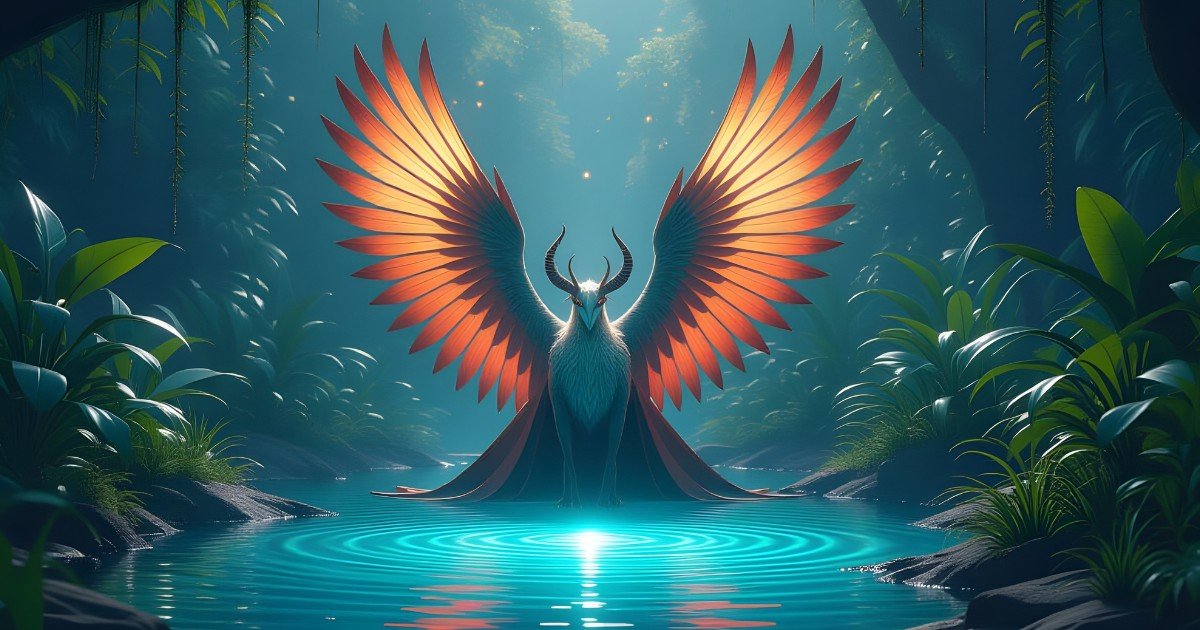
Like many of my stories, Riverborn germinated from an image I had created. An image of a sublime creature, not quite human and not quite non-human, standing at the edge of a pristine river, gazing into its azure depths. I found the image so captivating that I created more like it, until I had a collection of a dozen or so, each one showing a slightly different form in the foreground. Some had feathers, others had wings, and one had horns.
All I had to do was lay the images out in a straight line to see the story arc. And the story began with a lovely creature rising from dark water, wings outstretched, neither entirely human nor entirely non-human. It seemed like something old that had been waiting beneath the surface for the right pressure to call it upward.
That first image evoked several questions: What would it feel like to emerge again and again into the world, each time in a different form? What would happen if each body carried a task, a wound, a purpose? What if the Riverborn was not one creature in the ordinary sense, but a pattern expressed through many bodies? What if water itself held the memories of everything that had entered it?
From there, Riverborn began to take shape as a sequence of emergences that eventually became a meditation on identity. If the creature appears as a bird, then a warrior, then a healer, then a luminous winged being, is it still the same creature? What makes it the same? The body changes. The abilities change. The temperament changes. The task changes.
Yet something holds because deep below the visible world, the river remembers everything that has happened. The river holds memory not in language, but in pattern: the direction of springs, the pressure of currents, the shape of an eddy, the way water leans against stone. The archive is not a library of books, but a living system of traces and impressions.
The original images that inspired Riverborn, along with the story itself, are available as a bundle on Gumroad, for anyone who would like to follow the current back to its source.
Our world is full of sensory memory that does not resemble human record-keeping. A tree remembers drought in its rings. Soil remembers what has been planted, burned, buried, or poisoned. A river remembers obstruction in the shape of its banks. A landscape remembers pressure.
In this sense, Riverborn has roots in eco-fiction as well as myth.
The story asks the reader to imagine that the river is not a passive backdrop to human activity, but a living presence with memory, feeling, and response. Human beings enter this world, but they are not automatically centered within it. From the river’s point of view, human actions can appear strange, careless, intrusive, even absurd. A machine breaking the land is not good for the land. A chemical leak is pain entering the body of the river.
The ‘moral’ of Riverborn, if there is one, is this: humanity has forgotten its place inside a larger ecosystem. The story does not argue that humans are uniquely evil. It simply asks what happens when a species becomes careless with its own power. Human beings are capable of great tenderness, imagination, restraint, reverence, and repair. But we are also capable of damaging what sustains us because we see the living world as something separate from ourselves.
It seems to be the small acts of maintenance that keep our world alive and Riverborn is full of those acts. Its drama is not simply whether the river can be saved. It is whether the Riverborn creatures can come to understand that purpose does not always feel triumphant. Sometimes purpose feels exhausting. Sometimes it feels futile. Sometimes it means returning again and again to wounds that should not have been made in the first place.
That part of the story feels emotionally honest to me because it reflects the burden of guardianship. Anyone who has tried to care for something vulnerable (e.g., a garden, a child, a body, a forest, a creative practice, or a relationship) will understand this. Care is not always soft. Sometimes it is repetitive, frustrating, and invisible. Other times it asks for endurance after inspiration has faded.
Nature is resilient, but not infinitely forgiving.
Transformation is wondrous, but not always comfortable.
Memory connects us, but also burdens us.
These tensions are what keep Riverborn alive for me because we humans are not fixed creatures. We are riverine. We carry what has touched us. We are shaped by places, people, wounds, dreams, stories, and longings we do not always understand. We emerge in different forms across a lifetime, each one answering a different need. The child, the warrior, the healer, the watcher, the artist, the guardian, the person who breaks, and the person who mends things all emerge from the same current.
To follow the current back to its source, you can download the book, and the artwork that inspired it, from Gumroad.
To receive a monthly summary of these posts, subscribe to my free email newsletter.