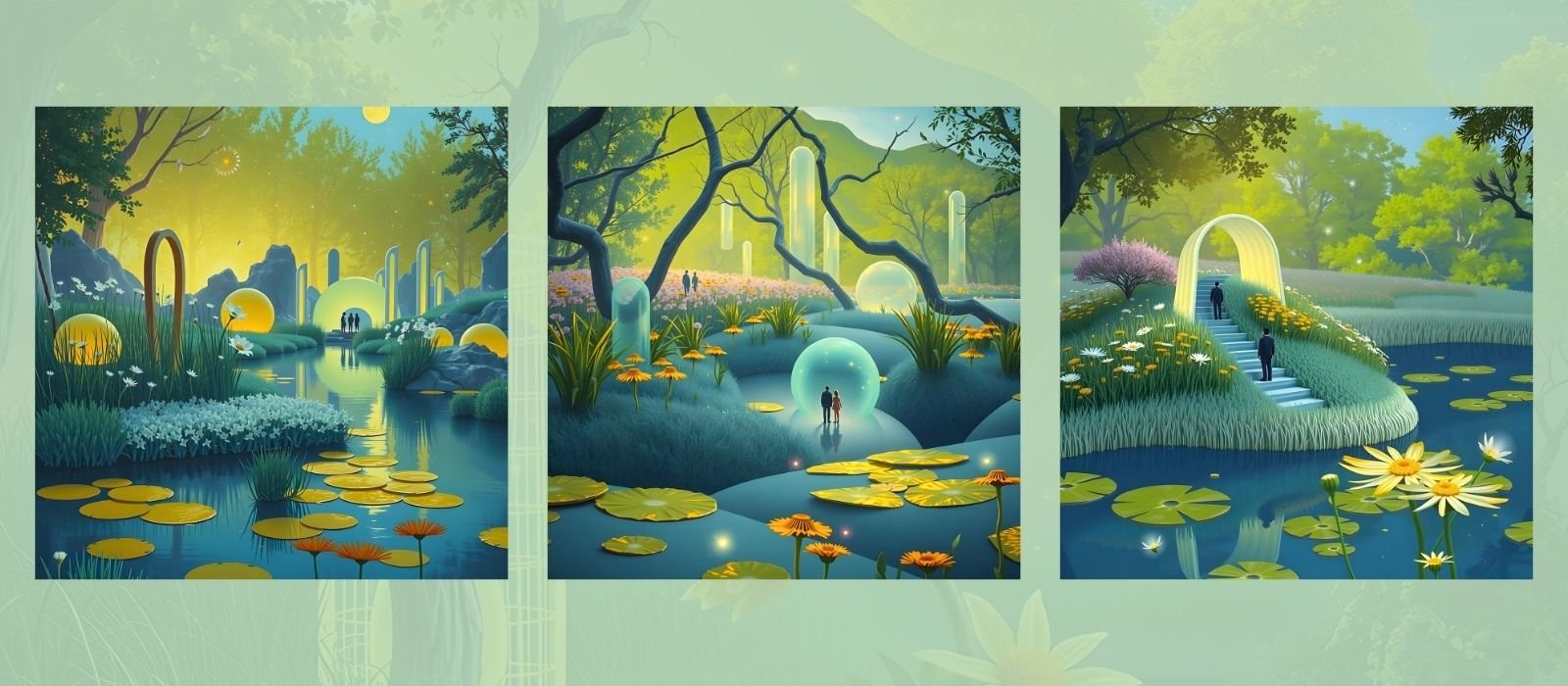
Sometimes an image gives you a world before you know the plot.
You may not know who lives there yet, what has gone wrong, or whose life is about to be disrupted, but you can feel the tension of change about to happen. The clue might be a certain kind of light, a curve of architecture, a path across water, a plant growing where a machine might have been, or a distant figure.
The image does not have to dictate the story but you can use it to open a portal in your own imagination, which is why it is so useful for creative writers. And it is especially useful for writers of solarpunk, eco-science fiction and other forms of speculative writing because we imagine futures shaped by ecological care, beauty, adaptation and collective survival.
Here are a few steps to get you started:
Start with the visual feeling
Your first response. Before analysing the image, notice your first response to it. Does it feel peaceful, sacred, strange, hopeful, fragile, controlled, abundant, abandoned, ceremonial, domestic, futuristic, ancient? Does it feel like a place of arrival, refuge, learning, worship, healing, exile or surveillance?
Sense the atmosphere. Your first emotional impression tells you what kind of story atmosphere the image is offering. For example, imagine a golden lily pond surrounded by curved arches, glowing spheres, flowers, water and distant figures. The first feeling might be calm, but the kind of calm that is deliberately shaped: the water is not just scenery, the plants are not just decoration, and the light seems to have a purpose. Already, the world is telling you about itself.
Identify the worldbuilding clues
Once you have the feeling, begin looking for evidence.
Architecture: What kind of architecture appears in the image? Is it angular, organic, monumental, delicate, hidden, transparent, ancient-looking, grown rather than built? What materials might it be made from?
Nature: How does nature behave? Are plants wild, cultivated, sacred, engineered, sentient, decorative, medicinal, structural? Do they soften the built environment, or are they the built environment? What kind of technology is present? Is it obvious or subtle? Mechanical or biological? Powered by light, water, sound, roots, crystals, memory, ritual, or something stranger?
Scale: If there are people in the image, are they tiny beside the landscape? Are they central or peripheral? Are they using the space, tending it, studying it, passing through it?
In solarpunk worldbuilding, these clues reveal how the society works. A city of glass towers says one thing. A garden of glowing arches and lily ponds says another.
Ask what the society values
Every designed space expresses values. A world filled with gardens, ponds and soft architecture may value harmony between human life and ecological systems. A world built around sunlight might value transparency, renewal and collective access to energy. A world where paths wind slowly through water and flowers might value contemplation rather than speed.
As writers of solarpunk fiction, our job is to go beyond the obvious by asking who maintains this beauty. Is it communal labor, automated care, a priestly class, a scientific guild, a symbiotic relationship with intelligent plants? Is the landscape a public commons, a private estate, a research station, a ceremonial place, or the preserved remnant of an older world?
A solarpunk story world becomes richer when beauty is connected to systems. The flowers are lovely. But who planted them? Who waters them? Who is allowed to walk among them? Who is kept outside the garden gate?
Add tension
This is where the story begins. A peaceful image can be a powerful prompt precisely because it invites us to ask what might disturb the peace. The conflict does not have to destroy the solarpunk vision. In fact, the most interesting tension often comes from protecting, testing or complicating it.
For example:
- The glowing spheres in the pond are energy sources, and one of them has begun to dim
- The lily pond is a memory archive, and someone has discovered that a portion of the collective past has been edited
- The garden was designed to heal contaminated land, but the process is taking longer than anyone admits.
Or perhaps the conflict is social. A visitor arrives from a harsher settlement and sees beauty as wasteful. A caretaker knows the garden is failing but fears causing panic. A young person raised inside this gentle system longs for danger, speed and elsewhere. A community that prides itself on harmony has quietly avoided difficult truths.
Find the character
Who belongs there? Once the world begins to take shape, ask who belongs there. Who feels at home in this landscape? A gardener-engineer? A child apprentice? A water archivist? A diplomat? A botanist? A musician who works with plant resonance? A maintenance worker who knows the city’s hidden systems better than its leaders do?
Who does not belong? It could be a refugee from a collapsed industrial zone. A sceptic. A thief. A corporate negotiator. A historian. A person who remembers the place before it became beautiful. Someone allergic to the very plants that sustain the settlement. Someone who thinks the garden is not paradise, but camouflage.
In solarpunk fiction, the most useful character is often the one whose relationship with the setting is uneasy. If the world is harmonious, find the person who hears the discord. If the world is beautiful, find the person who sees the cost. If the world seems utopian, find the person who asks what has been left out.
Turn the image into a writing prompt
Once you have explored feeling, clues, values, tension and character, you can turn the image into a prompt. Here are a few examples inspired by the solarpunk lily pond world used in the header image of this article:
- A city’s energy garden has bloomed every year for two centuries. This year, one pond remains dark
- A young caretaker discovers that the glowing spheres beneath the lilies are not machines, but sleeping organisms beginning to wake.
- A visitor from a dust-choked settlement arrives in a garden city and is horrified by its beauty.
- The community gathers each year to listen to the water archive. This time, the pond speaks with a voice no one recognizes.
- A child follows a line of golden flowers to a part of the garden that no adult admits exists.
Byt the time you have answered these questions, or ones like them, you have begun to create your story world.
About this artwork
I created the Bio-architectural Worlds collection as visual inspiration for writers, worldbuilders and imaginative creatives exploring solarpunk, eco-science fiction, botanical futures and strange possible landscapes.
You can view the Golden Lily Pond art bundle in my Etsy shop, WorldsInBloom
Download my free guide, 10 Ways to Use Atmospheric Digital Artwork