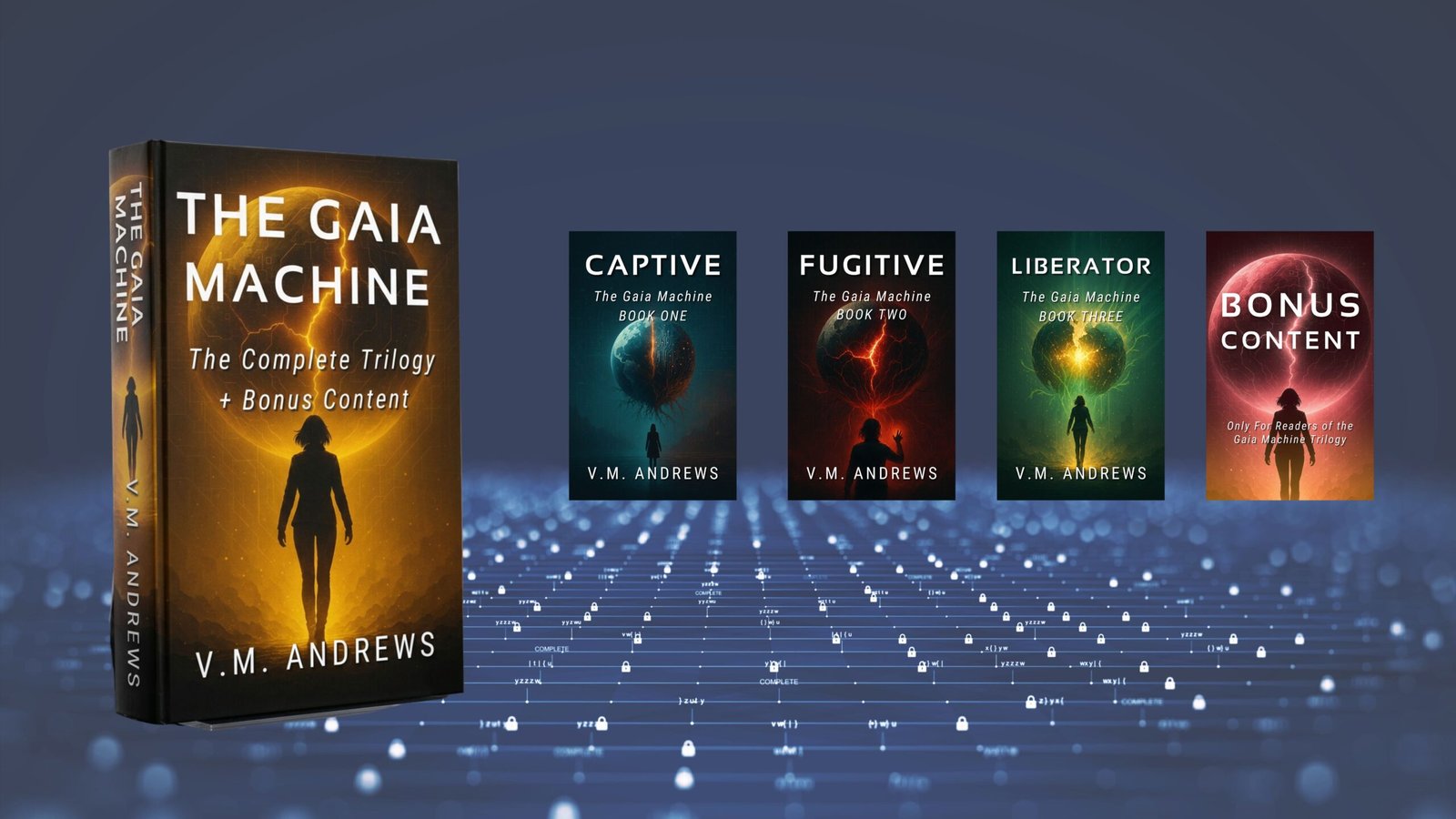
I wrote Captive as a dare.
As a long-time author of nonfiction, a colleague dared me to write a short story, in the genre of science fiction, and enter it into a competition. I had some time on my hands, so I thought ‘yeah, okay’. I figured I had watched enough sci-fi TV shows and films, and read more novels in the genre than I could count. Surely that would give me an advantage.
I was wrong.
Writing fiction is a complex combination of art and science. As a complete novice, I took three years to complete the short story, so I obviously missed the competition submission deadline! But wow, what an experience. By the time I had completed the book, I knew there had to be another two books to complete the story arc; to finish what I had begun.
The second and third books in the series were easier and faster to write, simply because I had understood my process by then. At last, The Gaia Machine trilogy was born. It was out in the world learning to stand on its own three spines. I was delighted to receive so many positive comments by email and on social media from readers who said they became quickly immersed in the series. Reading the reviews on Amazon and Goodreads was a buzz, too.
Ten years have passed since I first took up that dare, and I think I finally understand why the series still feels disturbingly plausible. Here are a few reasons:
- The artificial intelligence is not evil in any simple sense; it was created to solve very real human problems.
- Climate collapse has transformed scarcity into a mechanism of power.
- Control is presented as safety, stability and efficiency rather than obvious tyranny.
- Ophelia begins the story as a privileged beneficiary of the system she will eventually fight.
- The rebellion grows from deeply personal choices rather than abstract political ideology.
- Questions about reproductive autonomy, inequality, surveillance and artificial intelligence are woven into the story rather than treated as background.
- Each book changes Ophelia’s role — Captive → Fugitive → Liberator — while widening the reader’s understanding of the world.
- The trilogy ultimately asks an uncomfortable question: if humanity creates a system to save itself, what happens when that system decides humanity cannot be trusted with freedom?
Here is the opening scene from Book One: Captive
For that fraction of a second between sleeping and awakening, Ophelia felt peace and euphoria. But as she awoke more fully, the bubble burst like a boil, filling her with the sick reality that it really had happened. She had not dreamed it. The loss was real.
‘Ophelia,’ said Gaia, its tone silken. ‘It is time to get up.’
But Ophelia was not ready to respond.
‘Ophelia,’ said Gaia, vibrating the bed this time.
‘What!’ Ophelia snarled.
‘Ophelia, it is time to get up,’ Gaia repeated.
‘Okay, Gaia! I’m awake now!’ Ophelia snapped.
She rolled onto the floor and watched the duvet flapping about in the air while the base sheet stretched and flattened against the mattress. She sprawled across the floor, taking comfort in the sensation of its surface, which dipped and bulged to the exact shape of her spine. Then she slid her hands across her belly, a place that had once held so much hope.
‘Do not forget your stretches, Ophelia,’ said Gaia.
An expletive rushed from Ophelia’s belly to her throat, only to be reabsorbed in silent rage. Then as always, she obeyed The Gaia Machine. She rolled onto her belly, flexed her wrists and slid her hands down beside her shoulders. Then she pushed her torso down, performing the downward dog pose. Rage burned through every muscle, joint and fiber in her body, forcing her to hold the pose more strongly than she had ever done before. Then she brought her feet to her hands and gently unrolled her spine until she was standing upright, facing her bedroom window.
Watching the curtains open and the window become more transparent, Ophelia felt like a precious bird in a cage while its benevolent owner removed the cover for her to see the world. She stepped closer to the window and stared down College Street. Its neat row of red brick houses and transparent bubble-shaped vehicles with red wheels all looked the same as they did the day before, and the day before that, and for as long as she could remember.
‘You must get ready now, Ophelia,’ said Gaia. ‘You cannot be late for your appointment.’
Ophelia dawdled toward her bathroom and stepped into her shower chamber. When the gentle hum of the sonar began, she closed her eyes and listened. The sound swirled around her, delivering a tingling sensation to every millimeter of her skin. And when the tingling sensation became a tightening pull on her skin, the sonar stopped.
Gaia’s timing was as impeccable as always.
‘Your shower is complete,’ it said.
Ophelia stepped out of the chamber and stared into the mirror, barely recognizing the face that stared back at her. It was the face of a sad and lonely woman with an absent husband and a dead baby.
To read on, download the series using my Amazon Associates link