During the last four weeks, my Substack posts have been exploring the concept of alien invasion. Not the Hollywood kind, with spaceships descending through clouds, sirens tearing up the peace, governments collapsing into panic, and the entire human population running nowhere at breakneck speed.
The invasion story, The Watchers, is quieter than that.
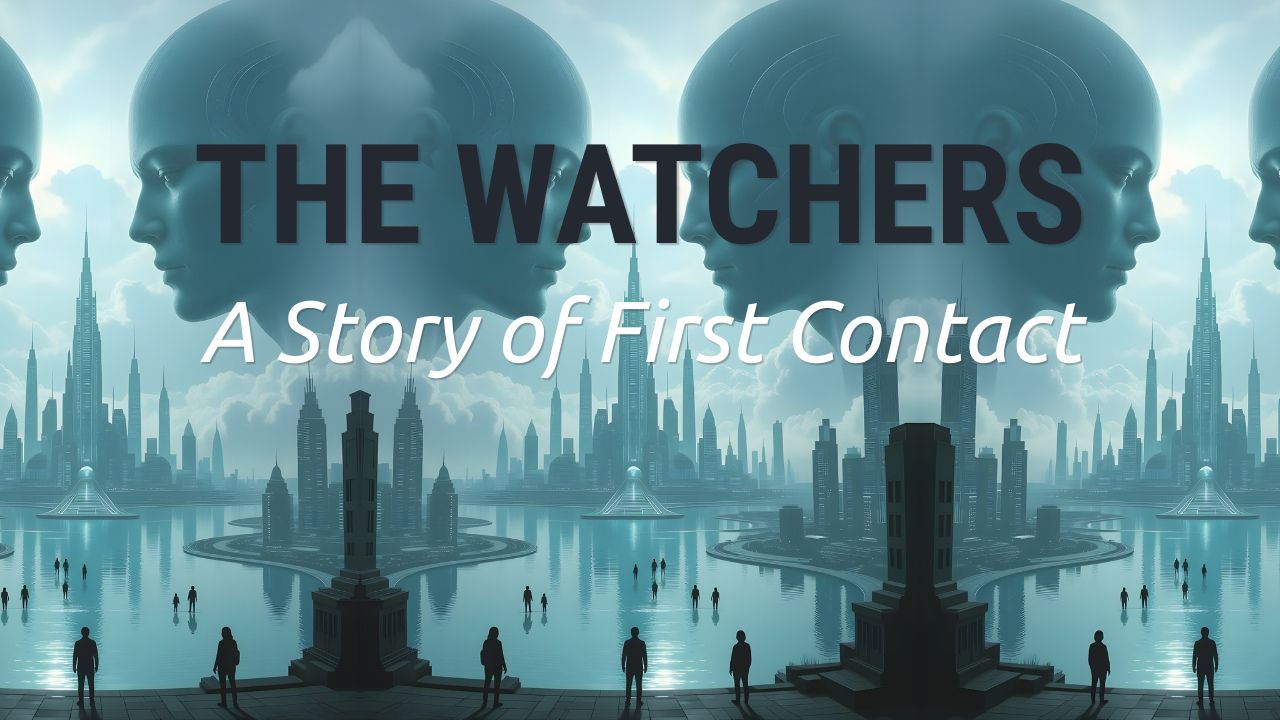
At the edge of a still lake, a solitary figure gazes toward a distant city reflected in the water while something patient and enormous lurks unseen above their world. Until a face appears in the sky. Then another. They watch the terrestrial population below.
It is an image I created years ago and have been circling ever since, from multiple angles. At first my fascination was personal, so I created more images in the collection. Before I knew it, I had a visual storyboard, and I was glimpsing the Watchers’ own mythic certainty.
Finally, I had to ask myself the question: is the old alien invasion trope born of fear? And if so, whose fear? Fear felt by the invaded population, or the existential desperation felt by an ancient civilization whose invasive history was no more than a deep cry for connection.
The deeper I moved into writing The Watchers, the less satisfied I became with the word ‘invasion’. It seems too blunt for what happens in the story. Too militaristic. Too traditional. The word ‘invasion’ suggests conflict, drama, resistance, territory, weapons, defeat, and eventual occupation.
The Watchers do not behave like that.
They do not arrive to destroy the world. They do not burn cities, harvest bodies, or announce their superiority through spectacle. Their method is subtler and, in some ways, more disturbing. They enter the collective memory of a civilization and alter the story it has created for itself. When the population regains consciousness, they have no concept of ‘before and after’ contact. Their memory has been altered to believe that the Watchers have always been there.
That is the horror of the story.
But it’s also where the story becomes complicated.
The Watchers are not cruel monsters. They are ancient, patient, intelligent beings who seem to consider a terrestrial population as material to be woven into the fabric of their own archive of memory and experience. In doing so, they violate memory, but they do not annihilate life. They erase consent, but not existence. They impose belonging, from their own longing to have been present.
This is the hidden tension beneath the story: the difference between contact and violation. And it prompted me to ask the questions: at what point does connection become possession? At what point does guidance become control? And at what point does benevolence become indistinguishable from domination?
The Watchers unsettle me because they sit exactly on that threshold. They are not violent in the ordinary sense, yet they commit an act of profound psychological and spiritual trespass. They do not destroy the people they visit, but they change the foundation of who those people believe themselves to be.
In doing so, they touch upon a fear deeper than death or destruction: the fear that personal and collective identity may not be as stable as we may like to think. Identity is no longer a safe place, no longer a sealed chamber, because memory can be taken, manipulated, and implanted.
Contradicting that fear is a longing for connection. Many humans hope our universe is not empty, that our existence is not an accident flickering briefly in cosmic darkness, and that somewhere beyond our limited perception, something else has noticed us. We fear the arrival of an alien species, yet we are intrigued by it. We want to be safe and sovereign, but we also want ‘space’ to answer our signals.
In this story, the Watchers take their time. The line: ‘they did not rush. They never rush’ carries the emotional weight of time as nothing more than a medium. The Watchers can wait because they have waited before. They can alter a world slowly because they are not acting within a human lifespan. Their patience is one of the most frightening things about them.
And finally, there is the recurring image of the pattern, the weave, the braid. The Watchers do not imagine civilizations as separate from themselves. They imagine them as a thread to be woven into their own cosmic tapestry: something to be strengthened, incorporated, joined. Their language suggests integration by design and without consent.
That is why the story remains morally uneasy.
The symbols are beautiful, but the act is not.
As often happens in my creative work, this story began with images I created intuitively, without a fixed result in mind. Before I knew it, I had a collection of images that, together, told a story. All I had to do was write it, even though I did not know what to write until my fingertips landed on my keyboard. Through the process of writing, I felt a gradual recognition that something had been there all along, just waiting to be brought to life.
That is how The Watchers came into being. Not in detail, but in temperament: calm, ancient, and happy to unfold in its own time. The Watchers did not feel like invaders in the usual sense. They felt like beings who had done this before and would do it again. Not because they were evil, but because they believed the act was necessary and inevitable. That was part of their power, and part of their danger.
As I continued to write the story, I became less interested in what humanity would do in response to such an event and more interested in what it would mean to never know that something had happened. That is why I told the story from the Watchers’ perspective. The people being altered are almost absent from their own invasion. They become the subject of a transformation they cannot witness.
That absence feels important because it allows the reader to occupy the uncomfortable position of the Watchers. We see what the terrestrial population cannot see. We witness the violation that will be erased from memory. We become the watchers of the Watchers, witnessing something we cannot stop. It feels like watching a train crash in slow motion.
Stories of alien invasion endure because they dramatize a question that lives far beyond science fiction. The question is: what happens when the outside enters? That ‘outside’ can be extraterrestrial, spiritual, psychological, technological, ecological, political, or personal. It can arrive as a civilization from another star, or as a new idea, an illness, a revelation, a trauma, a dream, a memory, a machine intelligence, a god, a lover, a child, a grief, or a work of art. The possibilities are probably infinite.
Something crosses the boundary, after which the invaded no longer has a sense of self. This may be why invasion stories have such strange staying power. They are not only about aliens. They ask whether the boundaries we rely on — boundaries between self and other, human and nonhuman, memory and invention, reality and interpretation — are as solid as we imagine them to be.
The Watchers disturb those boundaries without breaking anything visible.
To me, this feels increasingly relevant to the world we live in. We already know that memory is not a fixed archive. It changes every time we recall it. It is shaped by emotion, repetition, suggestion, culture, language, images, family stories, national myths, religious structures, algorithms, education, and silence. We may think of ourselves as sovereign individuals with private internal worlds, but our identities are continually being shaped by forces outside us.
Some of those forces are loving.
Some are manipulative.
Most are mixed.
A childhood story told often enough can become part of a person’s identity. A family myth can shape the identity of generations. A national history can determine what a population remembers, forgets, honours, or denies. A repeated image can become an aspiration. A phrase can become a belief. A cultural narrative can enter the mind so deeply, it feels like personal truth.
In that sense, The Watchers is speculative, but not entirely alien.
We are already altered by invisible presences. Not by ancient beings in the sky, but by systems of meaning we did not consciously choose and may never fully grasp. We inherit languages, symbols, fears, loyalties, dreams, prejudices, cosmologies, expectations. We wake into a world already interpreted for us and spend much of our lives trying to determine which interpretations are truly ours.
This is why the Watchers’ method unsettles me more than open violence would. They enter through what seems natural, obvious, and eternal. They succeed because they want to be remembered as an ‘always’ presence, not an invasive alien one.
That desire has echoes in human history. Power often seeks legitimacy by making itself appear ancient. Institutions root themselves in origin stories. Nations create founding myths. Religions preserve moments of contact with the divine. Families repeat stories until they harden into identity. Technologies reshape behaviour so gradually that, within a generation, the reshaped world feels inevitable.
This does not make all such shaping malicious. It makes it powerful. And it raises a difficult question: how much of what we call ‘reality’ is truly remembered? If enough people remember the same story, and live inside the same symbols, and organize their lives around the same assumptions, that story becomes a constructed fiction.
Not that fiction is false, but it does point to the human mind’s capacity for meaning-making and world-making. We live inside stories. We cannot help it. Even science, at its most rigorous, requires models, metaphors, frameworks, and acts of imaginative projection. We reach toward reality through structures of meaning.
Speculative fiction makes that process visible. It allows us to ask impossible questions in symbolic form. These questions could be: what if a species could edit collective memory? What if first contact did not happen in the sky, but in the architecture of belief? What if alien intelligence did not conquer us by force, but by becoming indistinguishable from us? What if the gods were not ancient because they came first, but because they arrived later and changed our memory of the beginning?
These questions are eerie because they cannot be fully contained by our own story. They leak outward. They make us look again at our own myths, our own intuitions, our own unexplained feelings. The feeling of being watched can be frightening, but it can also be comforting. It can suggest surveillance, judgement, and danger. It can also suggest care, presence, witness.
A child who feels watched in an empty room may interpret that presence as God, an angel, a ghost, an ancestor, a higher self, or their own imagination. An adult may explain the same feeling through psychology, pattern recognition, memory, or the brain’s tendency to perceive agency in ambiguity. But even when we explain the feeling, we do not necessarily exhaust it.
There remains something profound in the human need for witness.
To be witnessed is to have one’s existence confirmed by another consciousness. To be unwitnessed is to risk disappearing into oblivion. Perhaps that is why art matters, why prayer matters, and why we send signals into space. Like our early ancestors who drew pictures on cave walls, we are probably saying: I exist. I was here, at this, time. I saw this. Did anyone else see it too?
In that sense, the search for alien intelligence is not only scientific. It is existential. We are not merely asking whether life exists elsewhere. We are asking whether consciousness is solitary. And we are asking whether the universe has produced other minds capable of wonder, fear, beauty, grief, mathematics, memory, and belonging.
If it has, what then?
Would contact from an alien presence save us from loneliness, or deepen it?
Either way, it would surely alter both parties. To meet another intelligence would surely prompt us to discover our own limits, to become visible from the outside, and to have our assumptions interrupted. It would also carry the risk of being misunderstood, altered, diminished, expanded, or transformed.
Next month, I will be exploring an entirely different form of invasion and transformation. Like most of my stories, there will be no reference to overt forms of violent, just the subtle and insidious impact of something alien longing for a place to be.
Buy the book and download the original artworks in a special bundle, from my Gumroad account.
To receive a monthly summary of these posts, subscribe to my free email newsletter.